What is the working principle of a voltage tester
The core working principle of a withstand voltage tester (also known as a voltage tester or high voltage tester) is to apply a specified high voltage test voltage to the tested electrical product, verify the reliability of its insulation system under rated withstand voltage by detecting leakage current and determining whether breakdown/flashover occurs. Essentially, it simulates the insulation wit
The core working principle of a withstand voltage tester (also known as a voltage tester or high voltage tester) is to apply a specified high voltage test voltage to the tested electrical product, verify the reliability of its insulation system under rated withstand voltage by detecting leakage current and determining whether breakdown/flashover occurs. Essentially, it simulates the insulation withstand capability of the product in extreme voltage environments and is a core equipment for electrical safety testing. It is widely used for insulation performance testing of wire and cable, motor, household appliances, electrical components and other products.
The workflow revolves around four core processes: high-voltage generation, voltage application, leakage current detection, and fault diagnosis. The principles of different types of voltage testers (AC/DC/power frequency) are the same, with only differences in high-voltage output form and applicable scenarios. The following is a detailed breakdown of the working principle:
1�、 Core component modules (hardware foundation for principle implementation)
All withstand voltage testers are composed of four core modules, which work together to complete the withstand voltage test and are indispensable:
Voltage regulation/high voltage generation module: The core is a step-up transformer (AC version) or a high voltage rectifier circuit (DC version), which converts the mains power (220V/380V) into the high voltage required for testing (commonly AC 0-5kV, 0-10kV, DC 0-6kV, 0-15kV), and the voltage can be continuously adjusted to meet the standard withstand voltage requirements of different products;
Voltage measurement module: Real time detection and display of the actual high voltage value applied to the tested object through components such as voltage transformers and voltage divider resistors, ensuring that the test voltage meets the standards correctly;
Leakage current detection module: connected in series in the testing circuit, it correctly detects the insulation leakage current (μ A/mA level) of the tested object under high voltage, which is the core indicator for judging insulation performance;
Control and fault determination module: preset withstand voltage value, testing time, leakage current upper limit threshold, real-time comparison of actual leakage current and threshold. If breakdown/flashover occurs, the high voltage will be immediately cut off, sound and light alarm will be issued, and fault information will be recorded.
2����、 Complete workflow (taking the most commonly used power frequency AC withstand voltage tester as an example)
Pre test calibration: Set test parameters - according to the national/industry standards of the tested product, set the test voltage value (such as AC 3750V commonly used in household appliances), withstand voltage holding time (usually 1min/5s), and upper limit of leakage current (such as 0.5mA/1mA), and calibrate the instrument to ensure correct voltage and leakage current detection;
Wiring of the tested object: Connect the high-voltage output terminal of the tester to the live parts of the tested object (such as motor windings and power cord cores), and connect the grounding terminal to the metal shell/grounding parts of the tested object to form a complete high-voltage testing circuit;
Key requirement: The non testing parts of the tested product should be insulated and isolated to avoid stray currents affecting the detection results;
Slow application of high voltage: gradually increase the output voltage through the voltage regulation module, and prohibit sudden voltage rise (to prevent damage to the insulation of the tested object caused by impulse voltage) until the preset test voltage value is reached;
Pressure holding detection: Maintain the preset high voltage unchanged and enter the pressure holding stage. At this time, the leakage current detection module collects real-time leakage current data in the circuit:
If the insulation performance of the tested product is good, the leakage current will be stable below the preset threshold, and there will be no breakdown, flashover, or arcing phenomenon;
If there are defects in the insulation of the tested product (such as insulation layer damage, aging, excessive gap), the leakage current will sharply rise beyond the threshold, or directly cause breakdown (circuit short circuit), flashover (air gap discharge);
Result judgment and high voltage shutdown:
Qualified: The holding time has ended, the leakage current is always within the threshold, there is no fault phenomenon, the instrument automatically cuts off the high voltage, and displays "test qualified";
Unqualified: During the pressure holding process, if the leakage current exceeds the standard/breakdown/flashover occurs, the control module will immediately trigger the high-voltage emergency stop (to prevent continuous damage to the tested product or safety accidents caused by high voltage), and at the same time activate the sound and light alarm, display "test failure" and record the fault data (leakage peak value, fault time).
3��、 The core differences of different types of voltage testers (adapting output forms to different scenarios)
The withstand voltage tester is divided into AC (power frequency), DC, and AC/DC dual-use according to the output voltage type. The core principle is the same, with only slight differences in high-voltage output and leakage current detection logic, and is suitable for tested products with different insulation characteristics:
Power frequency AC withstand voltage tester
Core: Output 50Hz/60Hz sine wave high voltage, simulate the AC voltage environment of daily product operation;
Features: Able to detect overall breakdown and flashover of insulation, sensitive to insulation gaps and air layer defects, suitable for high-voltage power equipment such as motors, transformers, switchgear, wires and cables;
DC withstand voltage tester
Core: Rectify and filter the power frequency AC high voltage to output DC high voltage. During testing, there is no capacitive charging current, and leakage current detection is more accurate;
Features: Will not cause charging shock to the capacitive insulation of the tested product (such as cables, capacitors), suitable for high-voltage cables, capacitors, lightning arresters and other capacitive products, and more suitable for on-site outdoor testing;
AC/DC dual-purpose voltage tester
Core: Integrated AC and DC high-voltage generation modules, with the ability to freely switch output forms;
Features: Suitable for testing multiple types of products, balancing accurate laboratory testing and flexible on-site testing, it is currently the mainstream model for industrial testing.
4���、 The judgment logic of core detection indicators (why leakage/breakdown is key)
The insulation material of the tested product (such as rubber, plastic, epoxy resin) is not insulating, and there will be very small leakage current under high voltage, which is a normal phenomenon; But the leakage current size directly reflects the density and integrity of the insulation layer:
The insulation layer has no defects: the molecular structure is dense, the leakage current is stable and far below the threshold, and it can withstand the specified high voltage without being broken down;
Defects in insulation layer (damage/aging/bubbles): High voltage will "penetrate" the insulation layer from the defect, forming a leakage channel, and the leakage current will rise sharply. If the defect is severe, high voltage will directly penetrate the insulation layer, forming a short-circuit circuit. At this time, the product is prone to leakage and electric shock accidents in actual use.
Flashing/arcing refers to the high voltage ionization of the air gap on the surface of the insulation layer, forming a discharge channel. Essentially, it is a "surface failure" of the insulation system, which also belongs to the failure of the withstand voltage test and can cause leakage of the product in high humidity/high voltage environments.
5��、 Principles of Safety Design (Core Protection of High Voltage Equipment)
The output of the voltage tester is dangerous high voltage, so the instrument itself integrates multiple safety protection mechanisms, which is also an important component of the working principle:
High voltage emergency stop: When breakdown/leakage current exceeds the standard, the high voltage output is cut off in milliseconds to prevent continuous high voltage output;
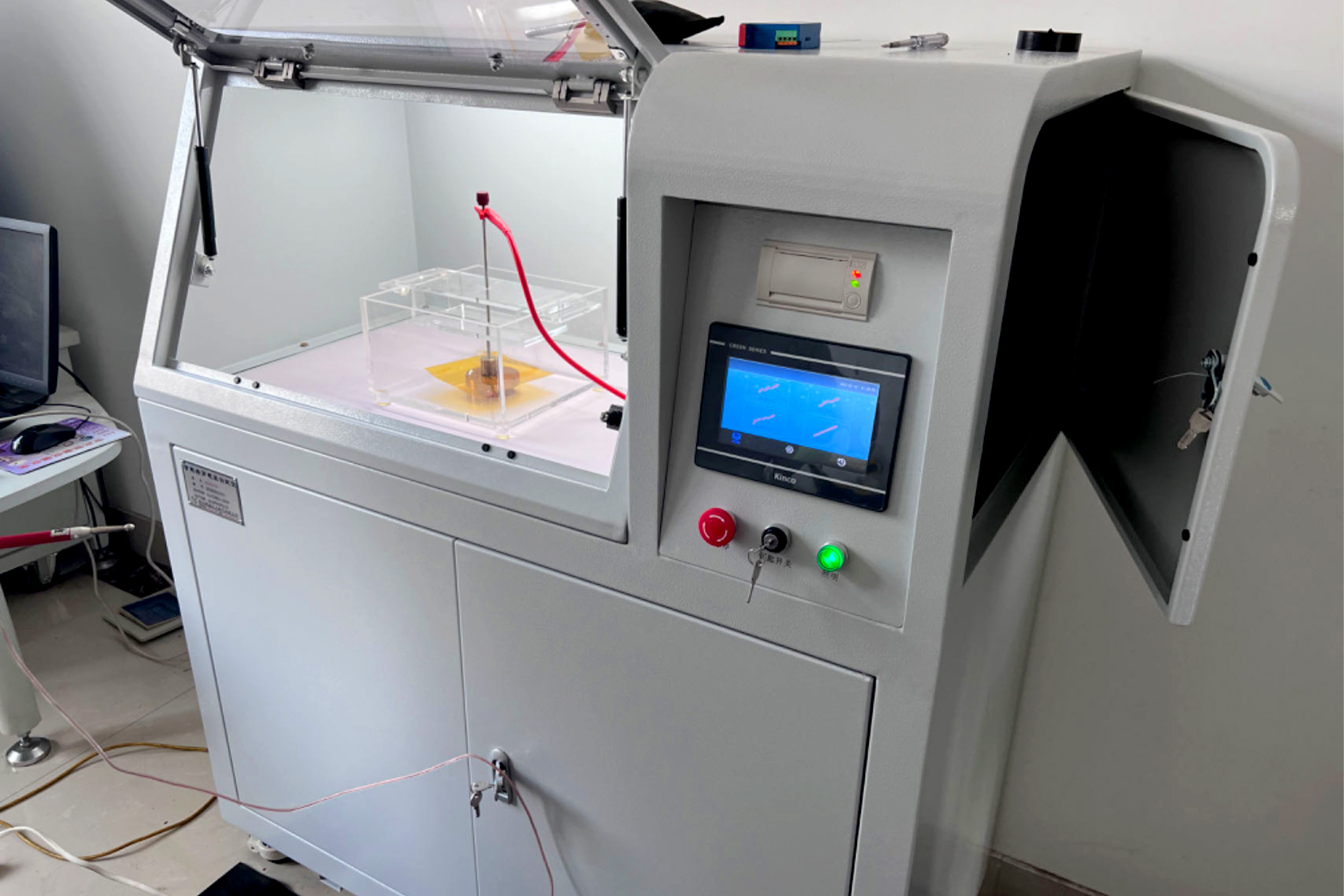
Door interlock/emergency stop button: The laboratory model is equipped with a test box door interlock, which cuts off power when the door is opened; The body is equipped with a physical emergency stop button, which can manually cut off high voltage in case of emergencies;
High voltage warning and current limiting: The high voltage output terminal is connected in series with a current limiting resistor, which can limit the circuit current even if a breakdown short circuit occurs, preventing damage to the tester itself; At the same time, the body has obvious high-voltage warning signs and sound and light prompts;
Zero position start: The voltage regulation module must return to zero position to start the high voltage output, in order to prevent voltage surge caused by starting under voltage.



 WeChat number:
 Home
Home
 Product
 Wechat
 Telephone